
The DTC pitch
Office managers running smaller fit-outs sometimes buy furniture directly from manufacturer websites or through online resellers. The pitch is straightforward. No dealer margin, faster checkout, products on your doorstep in a couple of weeks.
The math looks clean on paper. Manufacturer A on chairs, Manufacturer B on desks, Manufacturer C on conference tables, an online reseller for storage, a separate AV vendor for screens, a freelance installer to assemble it all, and a junk hauler for the boxes. Eight transactions, no dealer.
The line-item price savings can be real, often 8 to 15 percent against a dealer bid. The savings rarely survive the project.
What soft costs hide in DTC procurement?
Six categories of soft cost hide in DTC procurement.
Specification time. You become the specifier. Choosing the right task chair across 6 manufacturer websites takes 4 to 12 hours for someone who does this once. A specifier who does it weekly will finish in 30 minutes.
Coordination time. Different manufacturers ship on different schedules to different docks. Multiple delivery windows means multiple receiving days, multiple sign-offs, multiple loading dock reservations.
Damaged or wrong product. The single most expensive failure mode on a DTC project. A workstation arrives in 6 boxes, one of which is missing a hardware bag. The manufacturer has to ship the missing part. The installer waits 5 to 8 business days. The whole space waits with them.
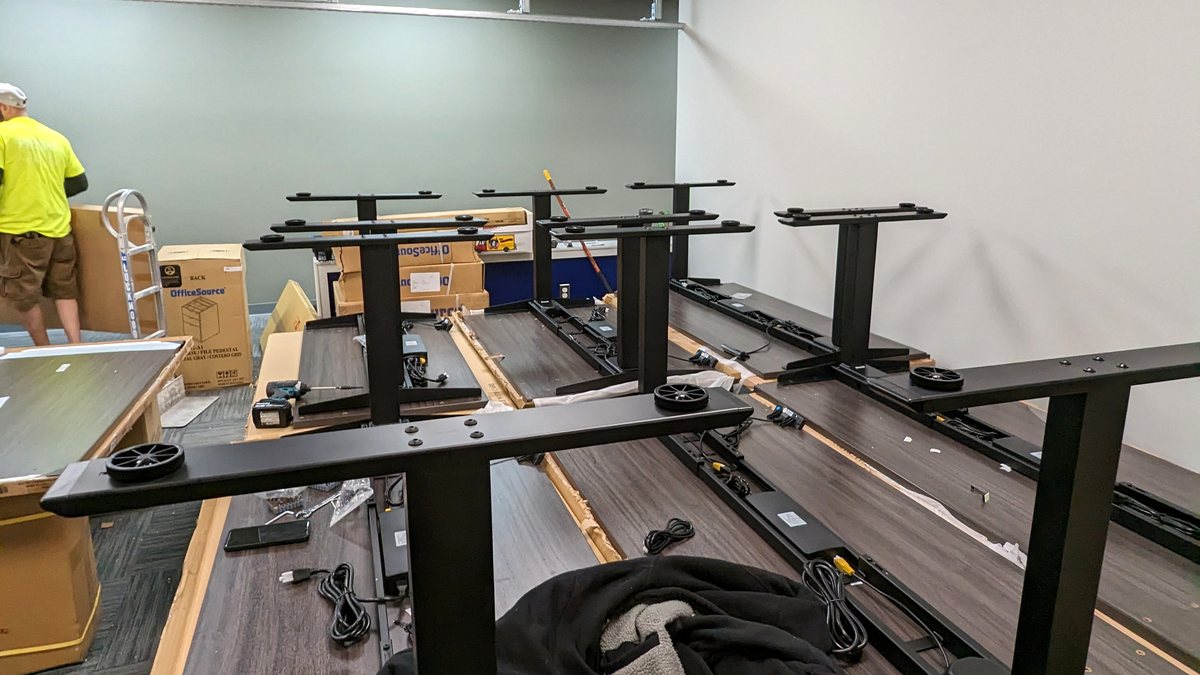
Installation. Most manufacturers do not handle installation. You hire an installer separately. Most installers will not install product from a manufacturer they did not purchase, because they cannot guarantee warranty work.
Returns. A wrong-finish desk on a DTC order goes back at your cost. A wrong-finish desk on a dealer order gets resolved by the dealer.
Punch list and warranty. Year two, a chair breaks. The manufacturer sends parts. You schedule the repair. You become the help desk.
What Vendor Sprawl Actually Costs
Here is how those costs added up on one real project. They land where a price comparison never looks: freight and returns on the errors, receiving day after day, a punch list with no single owner, and the paperwork that multiplies with every vendor.
50-person fit-out, real numbers from a project we audited last year. Client bought DTC across 7 vendors. Total furniture line $92,000.
Specification time: roughly 32 hours of office manager work at a fully loaded $95 per hour. $3,040.
Coordination time: 18 deliveries across 9 days. 28 hours of receiving and signing. $2,660.
Damaged or wrong product: 2 wrong chairs, 1 wrong desk finish, 3 missing parts bags. Return shipping and rework labor. $2,800.
Installation: hired 2 separate installation crews because no single crew would warranty work across all the manufacturers. Premium pricing. $8,400 vs roughly $5,200 dealer-managed.
Punch list time over 6 months: 22 hours of office manager time on chair adjustments and warranty escalation. $2,090.
Total soft cost: roughly $15,800 on top of the $92,000 line item. Effective project cost $107,800.
The dealer bid the client passed on came in at $98,500. The dealer bid was the cheaper outcome by $9,300, before factoring in 8 weeks of office manager time.
None of those lines counts the paperwork. Seven vendors meant seven orders, seven sets of invoices and warranty terms, and seven contacts to chase when something went wrong.
What Consolidation Looks Like in Practice
Consolidating does not mean settling for one brand. It means one dealer specifying across many manufacturers and handing you a single line-itemed proposal, so each product is still bid where it is strongest. That only works when the dealer has no exclusivity with one manufacturer and names every brand on the bid sheet, which is the test our guide to independent and aligned dealers sets out.
On the job itself, consolidation means one delivery schedule, one install crew and one owner for the punch list. Our walkthrough of installation day describes the goal as a single contact, a single schedule and a single crew, with a short punch list closed quickly.
Across several offices, the same idea becomes a standards program: approved products by function, prices agreed for the whole portfolio, spare parts that can move between sites, and one relationship for warranty claims, as our multi-site furniture standards guide describes.
Public agencies and schools have one more route: buying off a cooperative contract that someone else has already competed, which our guide to cooperative purchasing contracts covers.
When Multiple Vendors Still Make Sense
Three cases where direct procurement is the right answer.
Order is under 5 seats. The dealer overhead is not worth saving when the line item is small.
You have an in-house facilities specifier with manufacturer relationships. Some larger companies do. Most do not.
The product is a known-quantity reorder. If you are adding 4 of the same chair you already have, calling the manufacturer is fine.
Some work should stay with its own trade even on a consolidated project. AV, IT cabling and electrical connections, built-in millwork and fixed lab casework belong to their own specialists, and the furniture side coordinates where its product meets theirs, as our fit-out responsibility matrix lays out.
For anything else, the dealer is the cheaper path once you count the time.